
Roof 6: Roof Framing Answers
Contents:
Re-Roofing an Existing Roof
Framing a Gable End Overhang
Angle of a Roof
Number of Shingles to a Roof
Question about re-roofing an existing roof:
I want to re-roof/shingle my house. I think there are three composite layers on there now and the house is a single level 1500 sq ft rectangle when viewed from the top, not a very complicated looking job.
Answer:Re-shingling a roof is not that hard, but with three layers on it now you have to remove everything right down to the sheathing. A roof is designed to hold no more than 3 layers of shingles on it. Most shingles weigh about 210 to 250 pounds per square (a square is 100 square feet: 10' x 10'), so you can see why the 3 layer rule.
Make sure you tie yourself off to the ridge of the roof if it is a steep pitch, by using a good sized eye screw or plate for that purpose.
Start at the ridge of the roof and take off the caps and then continue down the roof removing the shingles. A garden spade works well. They make a roofers tool for removing shingles with a wedge under the spade to help lift the shingles off, making it easier.
When the shingles are all off, go over the entire roof deck and nail in any loose nails and pull out any sticking up, there will be alot of them. Don't just hammer them over. Either nail them in all the way or pull them out, completely.
Next, around the eaves of the roof install a 50 pound roofing felt that is non-perforated. This prevents any ice from backing up the roof and water going through.
Then cover the entire roof deck that is left with a 15 pound non-perforated roofing felt, overlapping the joints by at least 4".
Start at the eaves with your shingles. Depending on which type you are installing, there is a starter row to put on first. This protects the joints above it from water leaking in. Don't depend on the 50 pound roofing for this. Then continue up the roof.
Every bundle of shingles I've put on always had instructions including drawings on the installation. Exposure, nails, etc. So take a few moments to read the instructions from the manufacturer.
For the ridge and hip caps, I use the same color of shingle but in a butt style shingle. These come in 3 tabs per shingle. With a utility knife, cut the 3 tabs off and bend them over the ridge with an exposure given on the bundle.
Overhang the 50 lb. roofing felt and shingles about 1 1/2" at the eaves and about 1" at the gable. Don't overhang the 15 lb felt, keep it flush with the barge board, just overhang the shingles themselves.
Question about framing a gable end overhang:When installing barge rafters to support an overhang on a roof, using 2X6's, is there a standard (or recommended) spacing on how far apart to set the barge rafters? My overhang is 32", it's a 10 in 12 roof with a span of 17' plus the overhang. My rafters are on 16" centers and I'm going in three rafters due to the long overhang.
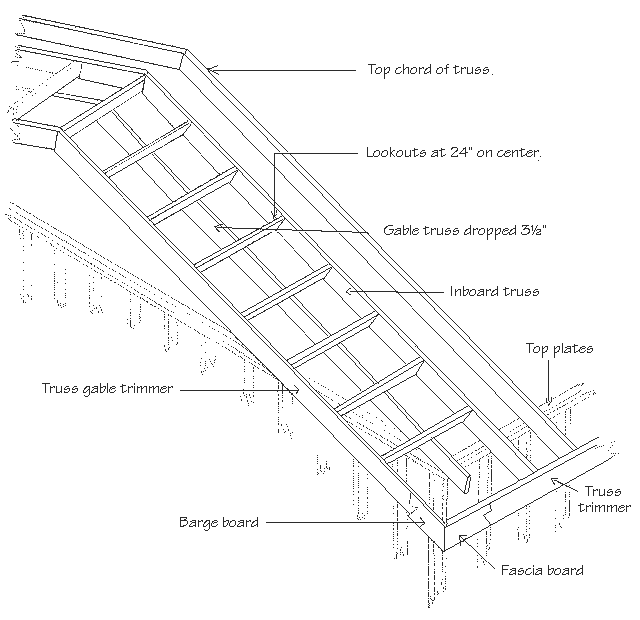
Answer:When framing for a gable end overhang, usually an overhang up to 16" can be done without building "ladders" or "look outs", as we call them, for the overhang. In your situation, with a 32" overhang you should use the ladder technigue as you have chosen. The rafters going out 90 degrees with the gable end usually sit on the gable end truss which is cut down by 3 1/2". The look outs then are 2x4 on edge and usually go inboard over the gable end truss into the next truss laid out on 24" centers. In your case with 2x6 rafters, I would do the same, except as you say remove one rafter from the gable end and attach the lookouts into the second rafter over from the wall line, at least 24" from the wall line.
On the wall line build your gable end rafter lower by 5 1/2" (or 3 1/2" would do, too depending on the choice of barge boards matching the fascia). These look outs should be laid out on 24" centers starting from the eave where your sheet of plywood starts. May as well have the 4' joint of the plywood butt up on one of the lookouts. Also, the ridge board should continue and catch the overhang rafter on the top and the rafter trim catch the bottom. When installing the plywood, try to get most of the sheet on the roof to help support the overhang. Stagger the sheets here by only 16" with the longest sheet in the center of the span. That is to make sure the overhang sheet nails into a rafter at least one inboard from the lookout connection. This way, your sheathing helps support the overhang, too.
Here is a drawing to help explain. This can apply to rafters, as well:
What is the formula to convert roof pitches
to degrees? Answer:You will need a scientific calculator to make use of the formula or just use the table below. The formula is:
angle of roof = atan(inches of rise/12)
Here are the angles for each inch of rise per foot:
	Rise      Angle in Degrees

	  1             4 3/4
	  2             9 1/2
	  3             14
	  4             18 1/2
	  5             22 1/2
	  6             26 1/2
	  7             30 1/4
	  8             33 3/4
	  9             37
	 10             39 3/4
	 11             42 1/2
	 12             45
Question about number of shingles to a roof:
How do you determine the amount of shingles you need to cover a roof?
Answer:Measure the roof surface carefully. Each 100 square feet is called a square. There are usually 3 or 4 bundles in a square. Ask your supplier how many bundles in a square of your choice of shingle or give him the square footage and he will tell you. Also measure the eaves of the roof, the part that has the gutter attached. This gives the lineal feet of starter shingle and eave protection, usually of 50 pound, non-perforated roofing felt. Also measure the ridge and hips for shingle caps. Finally measure the valleys for valley flashing. It is a good idea to replace chimney flashings that go on the roof, other flashings and roof vents, as well.
Dave
Your source for building tips, woodworking & furniture plans, house plans and building advice directly from Dave...
Hi, I'm Dave Osborne. With over 50 years experience as a journeyman carpenter, foreman and contractor in heavy construction I enjoyed working with apprentices and sharing the tricks of the trade that others shared with me. Now I get emails from Members all over the world and we include many of my answers in our Free Monthly Newsletters. Some of my answers include drawings and instructions specific to a project, but may also answer your questions. I use correct construction terminology, so you can confidently inform your building supply dealers or contractors exactly what you need.
ASK DAVE!
The Benefits of Membership
Membership gives you full access to our hundreds of how-to articles, woodworking plans, converters, calculators and tables. Our Stair Calculator is one of the most popular on the internet. We have projects you can build for (and with) your kids, furniture for your wife, and sheds and gazebos. If you run into a problem or need advice your Membership includes unlimited email questions to me through our Ask Dave quick response button.
Join us!
Copyright © 1999-2026 DDFM Enterprises. All Rights Reserved. DDFM ENTERPRISES, DAVE'S SHOP TALK and the Dave Osborne logo are trademarks and service marks owned by DDFM Enterprises. All other trademarks on this site are the property of their respective owners. Site design by Design Strategies, Inc.